About

Welcome to my website! I am a Behavioral and Experimental Economist working on topics related to inequality, fairness, and social norms. My research focuses on the perceptions and consequences of inequality, and on how social norms and identities shape economic and political behavior.

Currently, I am working as a postdoctoral researcher at the Centre for Experimental Research on Fairness, Inequality and Rationality (FAIR) at the Norwegian School of Economics in Bergen. Before coming to Bergen, I completed my PhD at the Centre for Decision Research and Experimental Economics (CeDEx) at the University of Nottingham.

Selected work

Strategic Behavior with Tight, Loose and Polarized Norms

with Eugen Dimant, Michele Gelfand & Silvia Sonderegger

Management Science, 2024PDF5-minute presentation (NoBeC Early Career Researchers series)

Descriptive norms -the behavior of other individuals in one's reference group - play a key role in shaping individual decisions in managerial contexts and beyond. Organizations are increasingly using information about descriptive norms to nudge positive behavior change. When characterizing peer decisions, a standard approach in the literature is to focus on average behavior. In this paper, we argue both theoretically and empirically that not only averages but also the shape of the whole distribution of behavior can play a crucial role in how people react to descriptive norms. Using a representative sample of the U.S. population, we experimentally investigate how individuals react to strategic environments that are characterized by different distributions of behavior, focusing on the distinction between tight (i.e., characterized by low behavioral variance), loose (i.e., characterized by high behavioral variance), and polarized (i.e., characterized by u-shaped behavior) environments. We find that individuals indeed strongly respond to differences in the variance and shape of the descriptive norm they are facing: loose norms generate greater behavioral variance and polarization generates polarized responses. In polarized environments, most individuals prefer extreme actions - which expose them to considerable strategic risk - to intermediate actions that minimize such risk. Furthermore, in polarized and loose environments, personal traits and values play a larger role in determining actual behavior. These nuances of how individuals react to different types of descriptive norms have important implications for company culture, productivity, and organizational effectiveness alike.
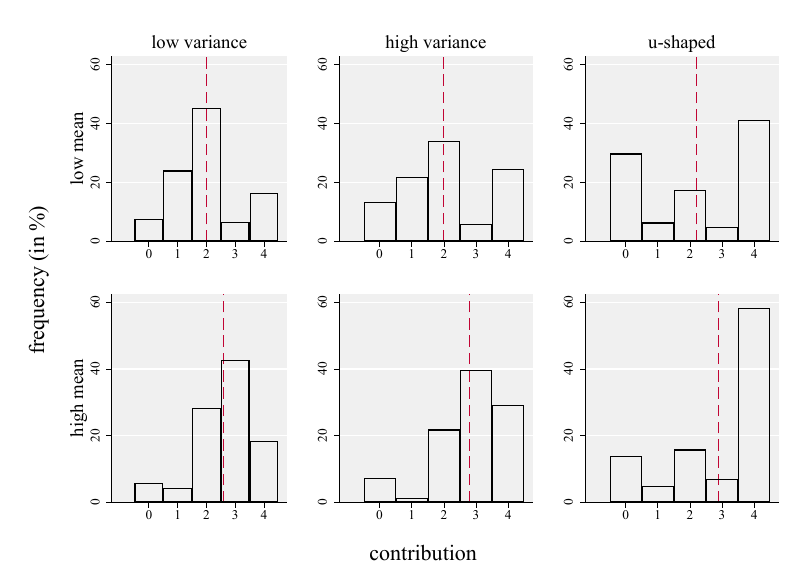
Six histograms of participants' contributions by treatment: low- and high-mean versions of low-variance, high-variance and u-shaped norms; contributions are most polarized under u-shaped norms.
Distribution of participants’ contributions by treatment. Dashed lines mark average contributions.

How Tinted Are Your Glasses? Gender Views, Beliefs and Recommendations in Hiring

with Markus Eberhardt, Giovanni Facchini, Valeria Rueda & Fabio Tufano

PDF

We study gender gaps in a multi-stage hiring process, focusing on recommendation and recruitment. Across two experiments - one with academic economists and one with a college-educated sample - we show how recommendation letters can cause gender hiring gaps. While recruiters favor female candidates, consistent with efforts to diversify hiring, some groups of recommenders choose less effective letters for women, undermining this advantage. Strategic but erroneous beliefs about letter effectiveness and gender views of recommenders explain these choices. A two-sample prediction exercise using letters from the academic job market supports the experimental finding that gender views drive the language used in recommendations.

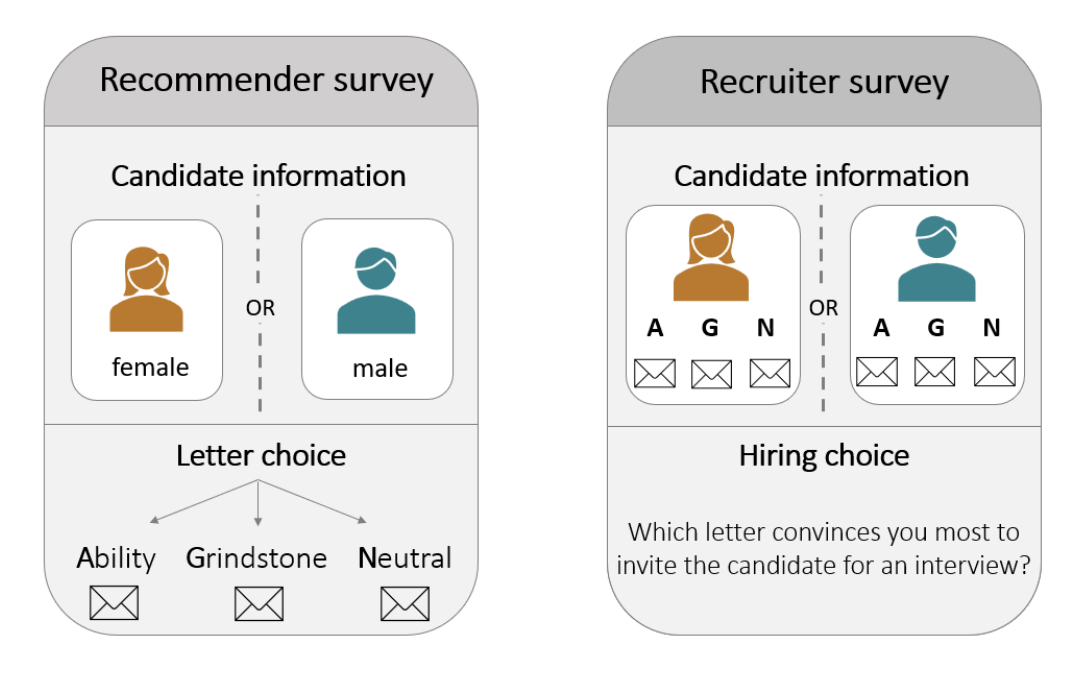
Diagram of the survey structure. Recommender survey: participants see one female or male candidate and choose an ability, grindstone or neutral letter. Recruiter survey: participants see a candidate with all three letters and choose which letter convinces them most to invite the candidate for an interview.

The Stories We Tell: Societal Narratives and the Rise of the Far Right

with Malte Baader, Kai Barron & Jonas Kaiser

PDF

In two studies using AI-assisted qualitative interviews, we ask a representative sample of the German electorate (N=1013) to reflect on the most important societal events of the last 15 years. We document that far-right supporters construct systematically different narratives about the recent past. First, they recall different events - with a strong focus on migration-related issues. Second, even when they do consider the same events, they are more likely to blame the establishment and describe events more negatively and with greater emotional intensity. We further document that these narratives are associated with policy preferences, and that far-right supporters are more inclined than supporters of other parties to prioritize cultural over economic issues. Together, our findings reveal that partisan divides extend to how citizens remember and interpret shared national experiences.

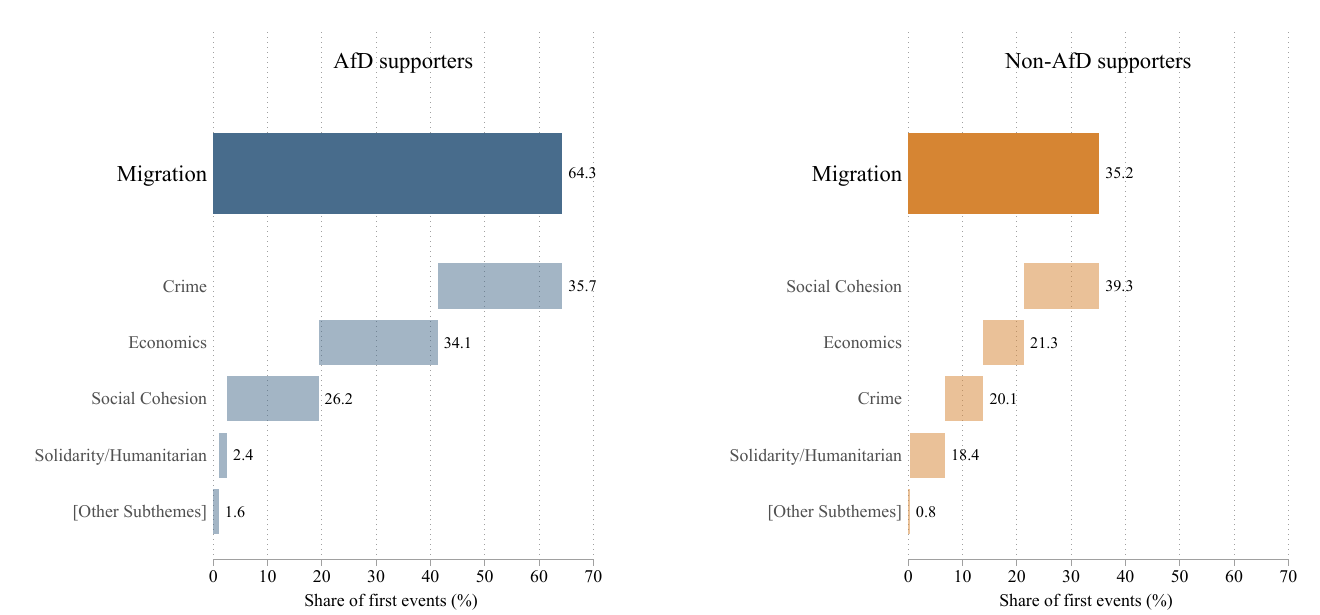
Bar chart: 64.3% of AfD supporters name a migration-related event first, versus 35.2% of non-AfD supporters, with crime and economics as the leading narratives among AfD supporters.
Share of AfD and non-AfD supporters who name a migration-related event first, and the narratives they attach to it.

Research

Publications 2

  • Strategic Behavior with Tight, Loose and Polarized Norms

    with Eugen Dimant, Michele Gelfand & Silvia Sonderegger

    Management Science, 2024PDF5-minute presentation (NoBeC Early Career Researchers series)

    Abstract

    Descriptive norms -the behavior of other individuals in one's reference group - play a key role in shaping individual decisions in managerial contexts and beyond. Organizations are increasingly using information about descriptive norms to nudge positive behavior change. When characterizing peer decisions, a standard approach in the literature is to focus on average behavior. In this paper, we argue both theoretically and empirically that not only averages but also the shape of the whole distribution of behavior can play a crucial role in how people react to descriptive norms. Using a representative sample of the U.S. population, we experimentally investigate how individuals react to strategic environments that are characterized by different distributions of behavior, focusing on the distinction between tight (i.e., characterized by low behavioral variance), loose (i.e., characterized by high behavioral variance), and polarized (i.e., characterized by u-shaped behavior) environments. We find that individuals indeed strongly respond to differences in the variance and shape of the descriptive norm they are facing: loose norms generate greater behavioral variance and polarization generates polarized responses. In polarized environments, most individuals prefer extreme actions - which expose them to considerable strategic risk - to intermediate actions that minimize such risk. Furthermore, in polarized and loose environments, personal traits and values play a larger role in determining actual behavior. These nuances of how individuals react to different types of descriptive norms have important implications for company culture, productivity, and organizational effectiveness alike.
  • Too Good to be True – Individual and Collective Decision-Making with Misleading Signals

    with Sebastian Fehrler & Moritz Janas

    Management Science, 2026PDF

    Abstract

    In many situations, an abundance of misleading evidence—such as fake customer reviews—can lead to false or deceptive conclusions. We experimentally investigate individual and collective decision-making in an information structure in which signals can be correlated, depending on the state of the world. In this setting, too much evidence pointing in one direction has the potential to mislead, necessitating a level of sophistication for rational decision-making. Overall, participants' performance is poor with only small differences in collective and individual decision-making accuracy. Interestingly, the more complex environment tends to encourage greater honesty within heterogeneous groups than a benchmark setting with independent signals, thus corroborating a rather subtle game-theoretic prediction.

Working papers 6

  • Does Inequality threaten Stability? Evidence from the Lab

    with Fabrizio Adriani, Abigail Barr & Silvia Sonderegger

    R&R at Games and Economic BehaviorPDF

    Abstract

    We investigate the impact of rising inequality on social instability through a novel multi-period laboratory experiment. In each period, members of two groups are randomly matched to play a battle of the sexes game, in which payoffs are either zero for both or positive but unequal. At the beginning of the game, the implied payoff inequality is low, but it increases over time. Our findings shed light on the effect of inequality on social stability. While under low initial inequality, unequal conventions - where one group is systematically better off - tend to emerge, increasing inequality causes destabilization. This is initiated by the group disadvantaged by the unequal convention and is particularly pronounced when not only the relative, but also the absolute position of the disadvantaged group is worsening. These findings are consistent with a simple model incorporating disadvantageous inequality aversion. Finally, we show that history matters; responses to current inequality depend on past experiences of inequality and stability.

  • To hide or not to hide? How fear and futility affect the decision to report a mistake

    with Malte Baader, Sarah Bowen & Richard Mills

    R&R at Experimental EconomicsPDF

    Abstract

    Even though reporting mistakes could substantially improve work processes and productivity within organisations, employees often hesitate to do so. This paper studies the role of fear (of being fired) and futility (i.e. reports being inconsequential) in explaining such employee silence. Drawing on a principal-agent framework with career concerns, we formalise mistakes as noisy signals of both agent quality and the work environment and show that optimal reporting decisions are affected by fear and futility considerations. We then use a novel experiment to exogenously manipulate the degree of fear and futility and test our theoretical predictions. In a 2x2 between-subject design, we vary the anonymity of reporting and the likelihood of organisational response. Results show that reducing fear and futility are complementary actions. Tackling both significantly increases reporting by about 20pp. This improvement in communication is accompanied by better organisational income, highlighting the value of improved reporting structures for firms and employees.

  • Negative income shocks and distributive preferences

    SubmittedPDF

    Abstract

    This paper investigates how individuals understand fairness in the presence of negative income shocks. I combine evidence from two dictator-game experiments. In the first, income shocks are randomly assigned within the experiment; in the second, I use information on participants’ real-world income losses during the Covid-19 pandemic. Across both settings, shocks significantly affect distribution decisions. Individuals allocate more to those who lost income, regardless of whether they themselves or another person were affected. This effect cannot be explained by need considerations alone: even if two individuals have the exact same income at the moment of the distribution decision, participants allocate more to the person who suffered a shock. This highlights that the mere experience of shocks matters and is in line with a theoretical framework where past earnings serve as fairness reference points. Finally, I find that if information about shocks or reference points is incomplete, individuals use this ambiguity in a self-serving way.

  • How Tinted Are Your Glasses? Gender Views, Beliefs and Recommendations in Hiring

    with Markus Eberhardt, Giovanni Facchini, Valeria Rueda & Fabio Tufano

    PDF

    Abstract

    We study gender gaps in a multi-stage hiring process, focusing on recommendation and recruitment. Across two experiments - one with academic economists and one with a college-educated sample - we show how recommendation letters can cause gender hiring gaps. While recruiters favor female candidates, consistent with efforts to diversify hiring, some groups of recommenders choose less effective letters for women, undermining this advantage. Strategic but erroneous beliefs about letter effectiveness and gender views of recommenders explain these choices. A two-sample prediction exercise using letters from the academic job market supports the experimental finding that gender views drive the language used in recommendations.

  • Divided We Act: The Role of Social Sanctions in a Polarized World

    with Eugen Dimant, Michele Gelfand & Silvia Sonderegger

    PDF

    Abstract

    Social sanctions sustain social order by reinforcing widely accepted principles. Political polarization may weaken this mechanism by fragmenting these principles, yet causal effects are hard to identify: observational data cannot separate the impact of polarized preferences from exposure to polarization. We test the effectiveness of social sanctions in a representative U.S. experiment (N = 2,400) that exogenously varies the degree of polarization. Participants allocate money between politically opposed recipients privately and publicly. When allocation choices are public, they can be punished by partisan Observers whose values are drawn from one of three distributions: tight (low variance), loose (high variance), or polarized (U-shaped). We find that polarization makes public allocations less equitable because participants (correctly) expect they may be punished even when acting fairly. Our results thus show that polarization causally undermines the disciplining role of social sanctions.

  • The Stories We Tell: Societal Narratives and the Rise of the Far Right

    with Malte Baader, Kai Barron & Jonas Kaiser

    PDF

    Abstract

    In two studies using AI-assisted qualitative interviews, we ask a representative sample of the German electorate (N=1013) to reflect on the most important societal events of the last 15 years. We document that far-right supporters construct systematically different narratives about the recent past. First, they recall different events - with a strong focus on migration-related issues. Second, even when they do consider the same events, they are more likely to blame the establishment and describe events more negatively and with greater emotional intensity. We further document that these narratives are associated with policy preferences, and that far-right supporters are more inclined than supporters of other parties to prioritize cultural over economic issues. Together, our findings reveal that partisan divides extend to how citizens remember and interpret shared national experiences.

Work in progress 3

Teaching

Lecturer · Norwegian School of Economics

Evaluation scores: 1 = very dissatisfied, 5 = very satisfied

  • Behavioral EconomicsMaster students · Fall 2025 (score 4.2) · Spring 2026 (score 3.9)

Teaching Assistant · University of Nottingham

Evaluation scores: 1 = excellent, 5 = bad

  • Dissertation Computer Classes – StataScore: 1.4Lecturer: Sourafel Girma · Undergraduate Year 3 · Spring 2023
  • Introduction to Qualtricsnot evaluatedLecturer: Sourafel Girma · Undergraduate Year 3 · Spring 2023
  • Applied Econometrics IScore: 1.4Lecturer: Abigail Barr · Undergraduate Year 2 · Fall 2021
  • Mathematical Economics & EconometricsScore: 1.4Lecturer: Patrick Marsh · Undergraduate Year 2 · Spring 2021
  • The Politics of Economics and the Economics of PoliticiansScore: 1.6Lecturer: Cecilia Testa · Undergraduate Year 1–3 · Fall 2020
  • Quantitative MethodsScore: 1.4Lecturer: Fabio Tufano · Undergraduate Year 1 · Fall 2019

Tutor · University of Passau

  • Markets & Competitionnot evaluatedLecturer: Oliver Farhauer · Undergraduate Year 1–3 · Fall 2014 & Spring 2015